

A byline by Arnau Valdovinos
Germany’s health ministry expects around 300 tonnes of medical cannabis imports in 2026. On paper, Europe’s certified growers could cover that without a single kilogram of converted GACP flower. In practice, taking conversion away would open gaps faster than the market can close them, and those gaps would not fall evenly.
In September 2025 I wrote in Krautinvest about the bottlenecks building in the Canada–Portugal–Germany triangle. In July, about a supply chain that refused to consolidate despite a year of pressure. Both circled the same question: how much of what reaches German pharmacies depends on ‘greenwashing’ or GMP-conversion?
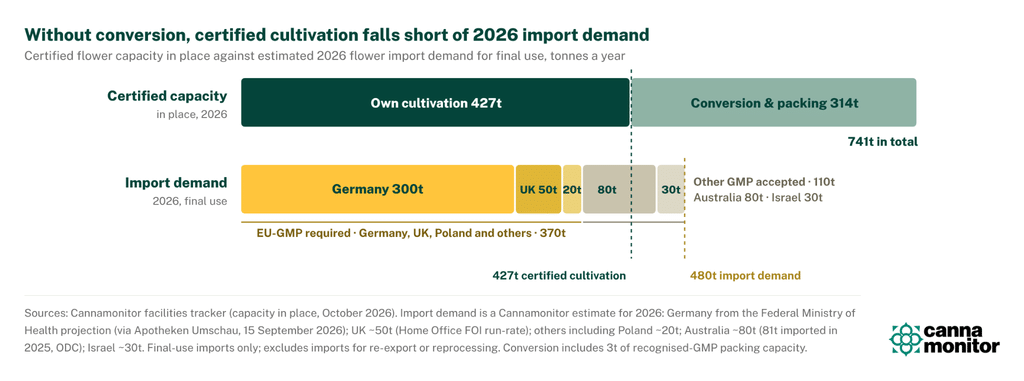
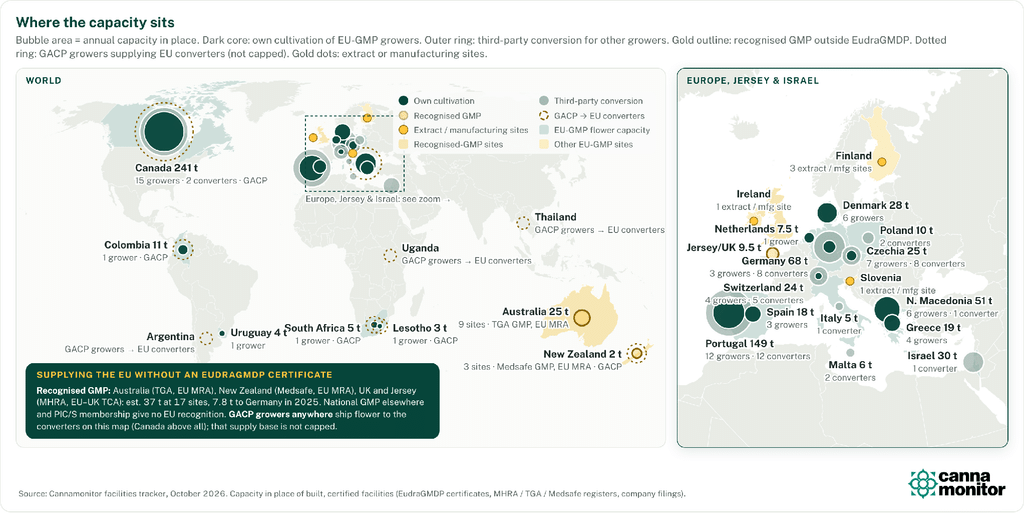
We now have a number, thanks to the analysis of 224 GMP certificates in EudraGMDP undertaken by Cannamonitor, plus 17 sites with EU-recognised GMP in Australia, New Zealand, the UK and Jersey. Together they can release an estimated 741 tonnes of flower a year, and 311 tonnes of that is conversion: capacity at sites that finish flower grown by someone else.
Two rules, two different markets
The question has come to the forefront of topics relevant for the German industry due to Hessen’s inspectorate setting out in June that flower released in the state must be dried and trimmed where it is harvested, treating drying as a GMP step. Furthermore, its August guidance asks for a per-supplier application mapping every GACP and GMP stage. As Krautinvest reported, most Länder now share that reading, including Hessen, home to importers such as Cansativa and Nimbus Health. Saxony-Anhalt, which certifies Aurora’s Leuna site and Quebec growers such as Green Karat and LOT420, still allows simple pre-drying under GACP. Saxony, home to Demecan or Cantourage, leaves it to the manufacturer’s validation.
This rule does not ban conversion. It bans the version that built the market: flower dried under GACP, shipped, then cured, trimmed and packed under GMP at a hub. Converters survive only if their GMP reaches back to the farm. The second is the hard version, the one this site put to Northern Leaf’s Steven Tan in July: cultivation and GMP processing on the same site, which would remove GMP-conversion altogether. The first is spreading Land by Land; the second is where this logic could eventually lead.
Enough capacity, very little slack
Take conversion out and 427 tonnes of certified cultivation remains: 394 tonnes at EU-GMP growers and 34 tonnes at recognised-GMP growers. In principle, that is enough to match Germany’s 300 tonnes. But Germany is not the only buyer. This year the UK will import around 50 tonnes and Poland and the smaller markets around 20 more, all of it under the same EU-GMP requirement as Germany. Australia (around 80 tonnes) and Israel (around 30) also accept other GMP certification. That is roughly 480 tonnes of import demand for final use in 2026, 370 of it tied to EU-GMP, before counting anything imported for re-export or reprocessing.
Capacity is also not output. The 28 certified sites that publish or reveal what they produce had an output of around 60% of their installed capacity. If certified growers as a whole ran at that rate, they would supply closer to 250 tonnes than 427, less than Germany alone expects to import. That is an estimate, not a forecast, but it shows how thin the margin becomes once converted flower leaves the system.
The gaps would concentrate in the most exposed supply chains, and some are larger than they look. Portugal supplied 55 tonnes of Germany’s imports in 2025, more than a quarter of the total, and most of its 149 tonnes of EU-GMP capacity exists to finish other growers‘ flower. In Czechia, six of seven certified growers also process third-party material. Even Canadian imports are partly converted: AgMedica’s Chatham site processes up to 60 tonnes a year for some 45 to 50 GACP growers, and Northern Green another 25 tonnes. Behind them sit importers whose catalogues lean on GACP partners in Colombia, Uganda or Thailand, and the cheaper price tier those partners supply.
Others are barely exposed. Integrated Canadian growers such as Pure Sunfarms and Aurora already dry under GMP, and Australian producers and Northern Leaf in Jersey supplied around 8 tonnes to Germany in 2025 on recognised GMP certificates, with more agreements signed since.
Time, not tonnes
None of this means Germany runs out of cannabis. It means a period of maladjustment, because the fix takes longer than the rule. A GACP grower that wants to keep its German customers needs a GMP post-harvest step at origin: a building, validated processes, a quality system and an inspection by a German Land or another EU authority, booked months ahead for a third-country site. Until that lands, its flower has nowhere to go and its importer has nothing to sell.
The market is already adjusting. Canopy, Aurora, Green Karat and BZAM all obtained direct EU-GMP certificates in 2026. EU-GMP growers with spare post-harvest capacity can open it to neighbouring farms that deliver fresh material, and converters can extend their own GMP system to partner farms, validating drying at the place of harvest instead of receiving pre-dried bulk. Each response adds supply; none happens in a quarter. Prices would show it first: conversion is a large part of why the lower-potency EU-GMP floor fell from €1.8 to €0.8 per gram in a year, and restricting it is one of the few things that could push that floor back up.
Regulators are right to define where GMP starts. Flower is a medicine, and a supply chain that cannot say where and how its product was dried has a problem. But how the line is drawn matters just as much. A clear, harmonised rule with a transition period would allow the capacity to move where the rule puts it. An unpredictable Land-by-Land reinterpretation, applied supplier by supplier, is how a market with a structural surplus could end up with a shortage.
Methodological note: capacity figures come from the Cannamonitor facilities tracker, built from EudraGMDP certificate scopes (October 2026) and the TGA, MHRA and Medsafe registers. Capacity in place is the stated capacity of a built, certified facility; 28% of it rests on Cannamonitor estimates. Import figures: German Federal Ministry of Health projection for 2026 (via Apotheken Umschau), BfArM, ODC and the UK Home Office.
About the author: Arnau Valdovinos is the founder and analyst of Cannamonitor, tracking regulatory and market developments across the European cannabis industry.
Guest articles reflect the views of their authors and not necessarily those of the editorial team.