

A byline by Arnau Valdovinos
Twelve months of regulatory pressure — Portugal’s licensing breakdown, Germany’s GMP tightening, amid increased competition and price compression — should have consolidated Europe’s medical cannabis supply into a handful of direct EU-GMP lanes: or at least that was a common thesis. So why does recent trading data show the opposite?
Last September, Krautinvest carried my analysis of the pressure building on the Canada–Portugal–Germany supply triangle. The consensus expectation then was that pressure would force simplification: fewer intermediaries, reduced regulatory risk, and supply consolidating into a small set of large EU-GMP gatekeepers to the German market.
Ten months of customs data later, the opposite has happened. Canada’s export book has tilted decisively toward Europe. In the first five months of 2026, Europe-bound shipments grew from 57.0 tonnes / CA$149.5 million in January–May 2025 to 129.7 tonnes / CA$237.5 million in the same window of 2026.
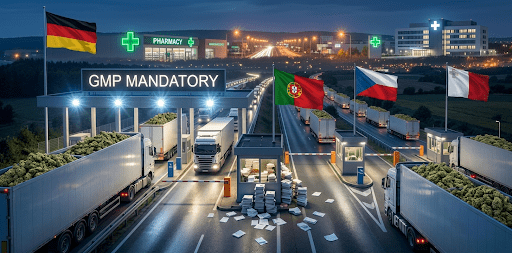
Within Europe, the trade has split into two lanes. Direct shipments to final markets like Germany and the United Kingdom now capture 60% of Europe-bound export volume but 79% of value, while processing hubs like Portugal and Czechia move 40% of Canadian volume but just 21% of value — direct shipments priced at roughly 2.6 times the per-kilogram rate of hub-bound cargo.
The regulatory backdrop: pressure at both ends of the chain
Portugal was long touted as Europe’s most efficient regulatory regime, its licensing and permitting rules under Infarmed allowing a fast track to market that other jurisdictions could not match. Operation Erva Daninha broke that reputation: 13 individuals and 11 companies charged with using the legal medicinal cannabis framework for trafficking.
The fallout is visible in the numbers. Since January 2026, more than 30% of licensed companies have been suspended or removed from Infarmed’s public lists, as surprise inspections met slow processing of renewals, which lapse while under review. Companies with no findings against them sit idle for months: not revoked, not refused, expired in a queue, despite absence from the lists not necessarily implying non-compliance.
Operators simultaneously report a communications blackout: calls, emails and registered lawyers‘ letters go unanswered, as Infarmed’s July semi-annual review omitted medicinal cannabis entirely. The regulatory demands, meanwhile, kept growing: since 8 May all import and export certificate requests run exclusively through a new web platform, quarterly traceability reporting became mandatory on 1 June, and certificate requirements were tightened — even as Infarmed admitted it had just one inspector-technician for the entire industry.
At the other end of the chain, Germany’s regional authorities have quietly raised the bar for processing abroad. As Krautinvest reported in July, most state medicines authorities now back Hesse’s 8 June leaflet: flower drying is a quality-determining manufacturing step that must run under EU-GMP, not GACP — continuously from fresh plant material, regardless of whether it happens in a third country or an EU member state. Only Saxony-Anhalt allows whole-plant „simple pre-drying“ under GACP, while Saxony defers to manufacturer validation.
This strikes directly at the GACP-cultivation → GMP-finishing split that underpins the Portugal-style conversion model — and, notably, at Portugal’s own regulatory advantage of separating the two. If drying must be GMP from harvest, the premium shifts to GMP capacity at or near origin, and to processors able to take GMP-dried input.
What the customs data shows: Germany pays, Portugal ships, Czechia climbs
In January–May, Germany more than doubled its direct intake of Canadian flower, from 25.4 to 56.6 tonnes, worth CA$162.9 million — roughly two-thirds of everything Canada earned in Europe over the period, as the United Kingdom grew sixfold to 19.3 tonnes / CA$20.8 million.
Meanwhile, despite expectations that supply chains might be re-routed around Portugal, Canadian shipments there still rose 45% to 37.9 tonnes. Recorded export prices, however, fell sharply to roughly CA$846 per kilogram, dragging value down 29% to CA$32.1 million — a trend that intensified in May, when Portugal moved ahead of Germany as a destination for Canadian flower, but at a blended CA$524 per kilogram against Germany’s CA$2,786. The hub role is not vanishing; its economics are eroding.
The main response to Portugal’s regulatory troubles seems to be the emergence of alternative processors — notably Czechia, which took in 11.3 tonnes / CA$13.7 million, eleven times its 2025 volume, at roughly CA$1,211 per kilogram. Malta tripled to around 1.1 tonnes on validated records — flagged low-price records hint at far larger flows — and Switzerland is emerging, up 245% to 2.8 tonnes.
Four lanes to market, then, and the toll booths matter more than the roads: Germany’s gate got stricter, Portugal’s stands unstaffed, and the traffic redistributed to Czechia and Malta rather than thinning out.
What it means for operators and exporters: volatility is likely to stay
No single successor to Portugal has emerged, and that is the finding. Portugal persists — at collapsed margins, under a regulator that enforces at 2am but does not answer its mail.
For Canadian exporters, the strategic implication is starker. Europe absorbed roughly 76% of Canadian medical cannabis flower export volume and 81% of export value in January–May 2026, up from around 64% and 70% a year earlier: Canada’s export book is now, in effect, a European book, leaving Canadian revenue hostage to European regulatory throughput.
Resilience in this market no longer means securing one good processing partner; it means multi-processor sourcing and geographic spread, because any single node can now be switched off by an unanswered renewal or a reinterpreted guideline.
A year ago, the reasonable bet was that pressure would simplify Europe’s cannabis supply chain. Instead, over 40% of the volume still moves through hubs, and through more of them than ever. The pressure was real. It just built a more complex machine.
About the Author
As the founder and principal consultant of Cannamonitor, Arnau Valdovinos (Linkedin) connects the dots of the global supply chain through an independent view of the international cannabis markets. An advocate for evidence-based drug policy reform, since 2018 Arnau has provided intelligence and practical advice to medicinal, recreational and CBD companies across 5 continents and 20 countries.
Disclaimer: Guest contributions do not have to reflect the opinion of the editorial team. No investment recommendation.